
My Exodus
A Journey to Liberation and Freedom

The term Exodus comes from the Greek word ἔξοδος (exodos), meaning "exit" or "way out." In the Bible, it refers to the departure of the Israelites from Egypt under Moses' leadership, symbolizing liberation and the journey to freedom. This foundational story is central to Jewish and Christian traditions, representing a divine intervention that led to the birth of a nation.
As I embarked on my own journey, I sought to understand Christianity in the hope of finding a denomination that resonated with me. However, the more I learnt, the more difficult it became to reconcile my previous beliefs with what I discovered to be true. My skepticism was not a rejection of faith but a quest for deeper understanding. It became clear that I wasn't turning away from God but rather seeking to comprehend the world and my place in it. This pursuit of knowledge, much like the Genesis story of the tree of knowledge, felt like a forbidden path - one that could challenge divine authority and alter my perception of the sacred.
Exodus, the second book in the Bible, has long been the subject of debate amongst biblical scholars, particularly regarding its historical accuracy. Despite its significance, there is a remarkable dearth of physical evidence supporting the large-scale migration of Israelites from Egypt as described in the text. Archaeological research in Egypt and the Sinai Peninsula has failed to uncover substantial evidence of millions of Israelites wandering the desert for forty years. This absence of evidence invites scrutiny and raises questions about the story's origins and the context in which it was written.
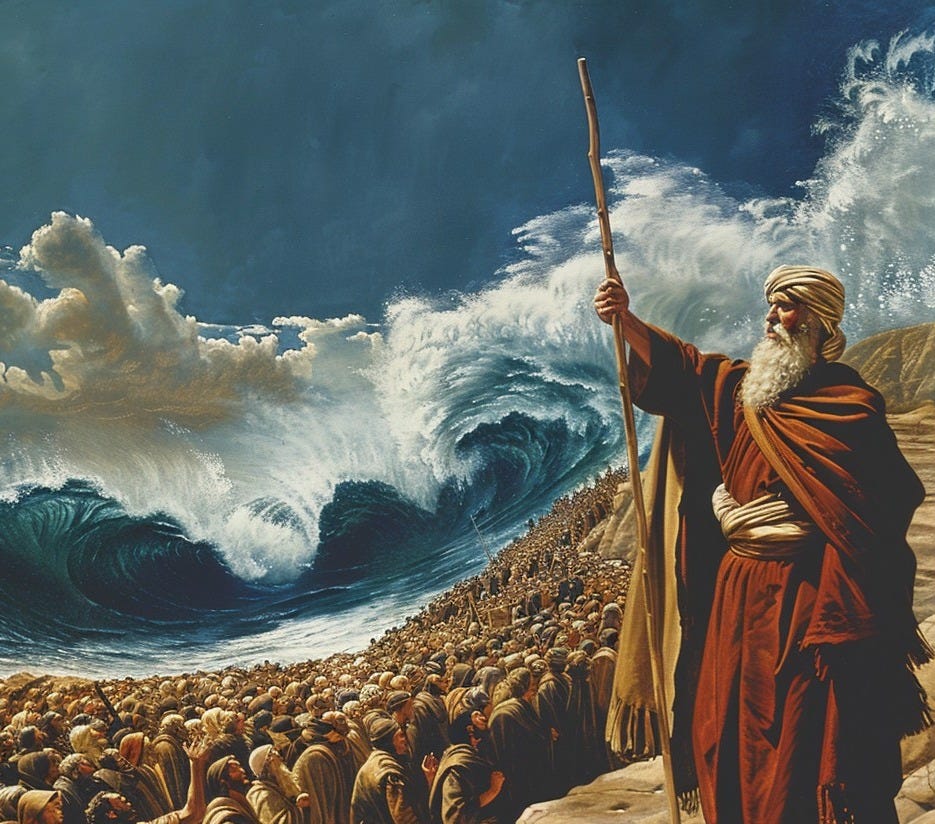
The story of the Exodus, while powerful and symbolic, faces significant challenges when examined through the perspective of history and archaeology. The Gradual Emergence Model - a well established hypothesis - for instance, suggests that the Israelites were originally Canaanites who gradually adopted the worship of Yahweh, rather than arriving as a distinct, conquering group. This perspective challenges the traditional biblical narrative of a dramatic, divinely orchestrated conquest and instead proposes that the Israelites' emergence as a distinct group was the result of internal evolution within the broader Canaanite cultural context.
The ethical implications of the Exodus story, particularly where God hardens Pharaoh's heart, are deeply troubling. If God deliberately manipulates Pharaoh's free will, it implies a premeditated plan to inflict suffering, not only on the Egyptians but on the Israelites as well. This raises questions about the morality of a deity who would cause such suffering to demonstrate power. It contradicts the notion of a benevolent God, presenting instead a deity more interested in control than in justice or compassion.
Further complicating matters is the concept of biblical inerrancy - the belief that the Bible is without error. Verses such as 2 Timothy 3:16-17, which states, “All scripture is given by inspiration of God, and is profitable for doctrine, for reproof, for correction, for instruction in righteousness: That the man of God may be perfect, thoroughly furnished unto all good works,” Psalm 19:7, “The law of the Lord is perfect, converting the soul: the testimony of the Lord is sure, making wise the simple,” and Proverbs 30:5, “Every word of God is pure: he is a shield unto them that put their trust in him,” suggest that the Bible is inerrant. However, the deprivation of consensus amongst evangelical scholars about what constitutes "inerrancy" undermines the claim that the Bible is a definitive guide. If the Bible were truly inerrant, one would expect uniform interpretation. Instead, divergent views reveal the subjectivity involved in interpreting these texts, suggesting that the doctrine of inerrancy is more about maintaining authority than discovering truth.
Linguistic studies show that the Hebrew language shares significant similarities with Canaanite languages, suggesting that the Israelites were not a distinct, divinely chosen people set apart from their neighbours but emerged from the same cultural milieu. The name Israel itself is derived from El, a common name for God in the Canaanite pantheon, indicating that the early Israelites likely worshipped El before merging this deity with Yahweh. This etymology and the fluid nature of religious beliefs in the ancient Near East challenge the idea of a monolithic worship of a single, true God as presented in the Bible.

Scholars like Bart D. Ehrman and John J. Collins have extensively explored how religious beliefs evolved over time, influenced by cultural, political, and historical contexts. Their work reveals that the development of the concept of God in the Bible was not static but shaped by surrounding cultures, further challenging the notion of a singular, unchanging divine truth. Collins, in particular, emphasizes that many biblical stories were literary creations designed to shape and solidify a collective identity, suggesting that the Bible served as a tool for social and cultural cohesion rather than a source of absolute truth.
The Bible's narratives, especially those concerning the origins of the Israelites, function as foundational myths crafted to create unity amongst a diverse group of people. These stories are not divinely inspired accounts but human-made constructs designed to serve specific social and political purposes, much like the founding myths of other cultures.
Critically examining the Bible, analysing its origins, contradictions, and historical context became essential for me to uncover the human influences within it. Many biblical scholars initially pursued their studies to deepen their faith, only to find that rigorous academic scrutiny exposed inconsistencies and contradictions. This often led to a crisis of faith rather than its reinforcement, illustrating how the Bible, when examined critically, fails to hold up as an inerrant document.
The Bible contains numerous troubling passages advocating violence, slavery, and the subjugation of women, which are usually ignored and not preached about in churches. This selective reading highlights the contradictions within the Bible and the mental gymnastics required to reconcile certain aspects of the text with a continued faith. This process undermines the claim that the Bible is a consistent and reliable moral guide.
Some evangelical interpretations of the Bible attempt to justify instances where God commands violence, often arguing that divine will is inherently just, even when it appears cruel. These justifications are deeply problematic, requiring us to accept actions that would be morally reprehensible in any other context. This blind acceptance of divine command undermines the very notion of morality.
The Book of Joshua recounts the Israelites’ conquest of Canaan, where entire populations were systematically exterminated, a chilling example of how religious texts can be used to justify genocide. This violent account brings forth serious ethical questions about the moral authority of the Bible. Deuteronomy 7, for instance, commands the Israelites to show no mercy and annihilate the inhabitants of the promised land. Despite the Bible’s condemnation of practices like child sacrifice, archaeological evidence suggests such rituals were carried out in the name of Yahweh long after they were supposedly abolished, complicating the idea of a clear moral progression in the text. Further emphasizing the Bible’s capacity for violence, Psalm 137 concludes with a verse blessing those who would dash infants’ heads against rocks.
The Bible often portrays the Israelites as the “good guys,” divinely chosen to carry out God’s will, even when it involves acts of extreme violence. This highlights a critical question about morality: can those who commit such violence truly be considered righteous simply because they are on the "right" side of God? This moral ambiguity challenges the concept of divine justice and suggests that the Bible’s distinction between good and evil may be more rooted in tribalism than in any universal ethical standard.
The concept of divinity in the ancient Near East was complex and fluid, reflecting a rich tapestry of beliefs and deities. The evolving relationships between El, Yahweh, and Baal illustrate the intricate development of these divine figures and their impact on the religious narratives of the Hebrew Bible.
El, the chief deity of the Canaanite pantheon, was regarded as the father of many gods, including Baal. In Canaanite mythology, Baal was a prominent storm and fertility god, revered for his control over natural forces such as rain and thunder. As one of El’s sons, Baal played a vital role in maintaining order in the natural world and combating chaos. This polytheistic structure reflects the broader religious context in which these deities were worshipped.
Yahweh, the central deity of Israelite religion, has a more nuanced relationship with El. In early Israelite history, Yahweh was understood within the framework of the Canaanite pantheon and was at times associated with El. Over time, however, Israelite religious thought evolved, and Yahweh gradually became identified with El, ultimately emerging as the singular, exclusive deity of Israel. This shift from a polytheistic system to monotheism marks a significant transformation in ancient religious traditions.
The syncretism between Yahweh and El highlights the fluid nature of ancient Near Eastern religions. As Israelite monotheism developed, early associations with El and other Canaanite deities were absorbed and reinterpreted, forming a distinct Israelite religious identity. This transformation not only reshaped the understanding of Yahweh but also influenced the broader religious landscape of the region.
The relationships between El, Yahweh, and Baal underscore the complexities of ancient Near Eastern beliefs and the evolution of divine figures within these traditions. Exploring these connections provides valuable insight into the emergence of Israelite religion and its interactions with surrounding cultural and religious influences.
At this point, it became clear to me that everything I thought I knew was wrong, and I had to adapt to this newfound understanding. The “God” I worshipped now appeared as a petty, vengeful, misogynistic, and malevolent deity. As I delved deeper into these stories, they began to unravel, revealing what I would consider childlike storytelling, embellished with mythical elements and moral lessons that no longer carried the weight of unquestionable truth. The more I examined their origins and inconsistencies, the more these stories resembled tales crafted to serve specific agendas rather than divinely inspired accounts.
I also realised that I didn’t truly know the Bible - what I knew was only what had been filtered through a preacher. It seems that many Christians don’t fully know the contents of their own sacred text either.
These stories, once the pillars of my faith, became symbols of a belief system that no longer aligned with the reality I had come to understand. My exodus from Christianity was not just a departure from these beliefs, but a journey toward a sense of liberation, freedom, and clarity that I had never experienced before.
Sources:
“Jesus, Interrupted: Revealing the Hidden Contradictions in the Bible (And Why We Don't Know About Them)”. Bart D Ehrman - HarperOne, 2009.
”Introduction to the Hebrew Bible” John J Collins - Fortress Press, 2014.
“The Tenth Plague and the Exodus” George E Mendenhall and Gary A Herion. The Biblical Archaeologist, 1957.
“The Bible Unearthed: Archaeology's New Vision of Ancient Israel and the Origin of Its Sacred Texts” Israel Finkelstein and Neil Asher Silberman. Free Press, 2001.