
Numbers, Patterns, and the Illusion of the Divine
Argument from Mathematics

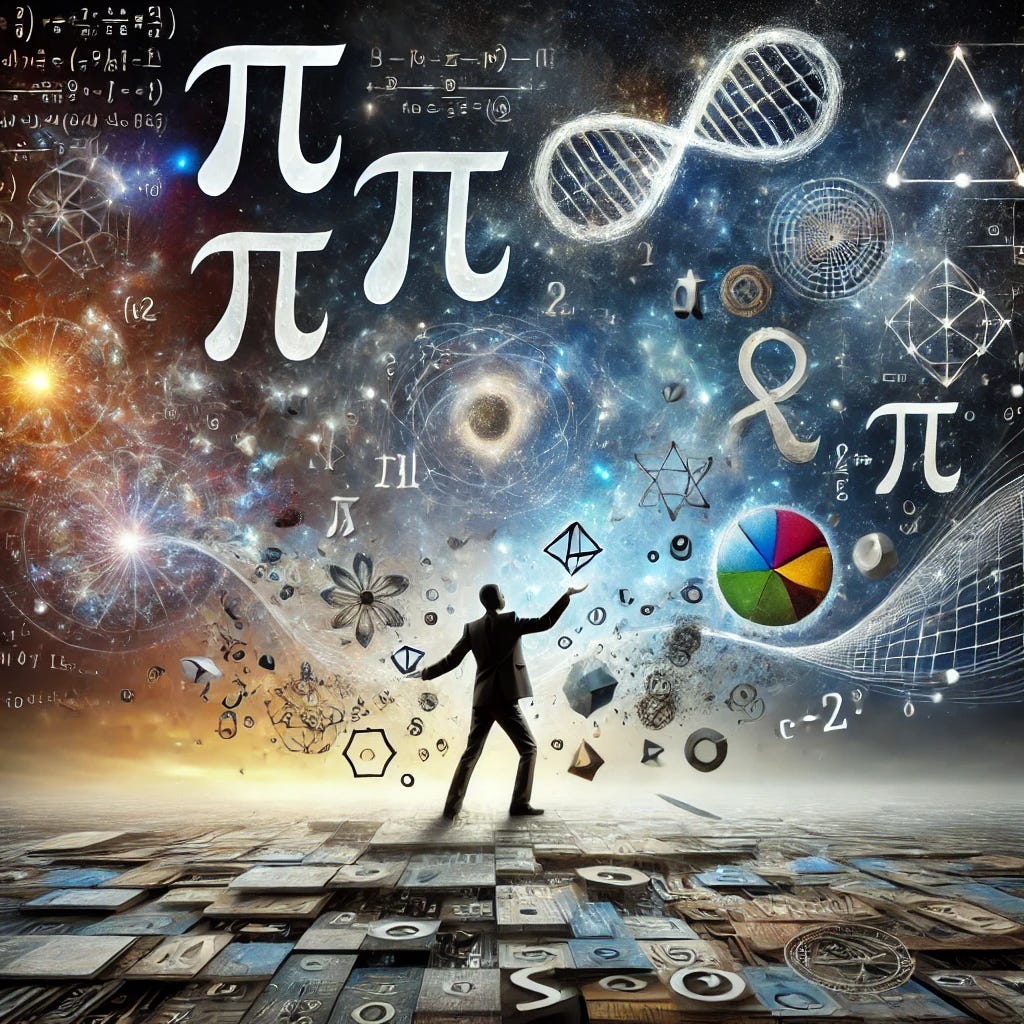
The Mathematical Argument for God posits that the elegance, universality, and apparent “other-worldliness” of mathematics point toward a divine creator. It also forms part of the Transcendental Argument. Proponents suggest that since mathematical truths exist beyond physical reality and yet intricately describe it, they must be the product of a transcendent, divine mind. However, a closer examination of mathematics, its nature, and its functions reveals significant flaws in this argument. Let’s explore why mathematics doesn’t require a divine origin and how the Mathematical Argument ultimately fails as a proof for the existence of God.
What Is the Mathematical Argument?
At its core, the Mathematical Argument claims that mathematical truths are evidence of a divine creator. This argument takes different forms but generally revolves around four main ideas:
Existence of Abstract Objects: Mathematics involves concepts like numbers, equations, and geometric forms, which some argue exist in an abstract, non-physical realm. Proponents of the Mathematical Argument claim that since these concepts are non-material yet appear real, they must come from a supernatural source.
Unreasonable Effectiveness: This idea, popularised by physicist Eugene Wigner, highlights how mathematical models accurately describe the physical universe. The idea here is that the universe seems to be written in the “language” of mathematics, implying an intelligent designer who crafted this mathematical order.
Consistency and Universality: Mathematics is consistent across different cultures and applications. The Pythagorean theorem, for example, which states that in a right triangle, the square of the hypotenuse is equal to the sum of the squares of the other two sides, is true regardless of where it’s applied. Advocates for the Mathematical Argument suggest that this universality points toward an ultimate, divine origin of mathematical truth.
Human Ability to Comprehend Mathematics: Humans’ ability to grasp and apply complex mathematical ideas is viewed as evidence of a higher, divinely gifted capacity. This suggests that humans were given a special ability to access divine knowledge in the form of mathematical truths.
Despite its appeal, the Mathematical Argument for God falls short as a compelling proof for a deity. Here’s why.
Mathematics is Descriptive, Not Prescriptive
A critical flaw in the Mathematical Argument is the misconception that mathematics dictates the workings of the universe. Proponents often assume that mathematical laws govern reality, implying that a divine mind wrote these laws. However, mathematics doesn’t create physical phenomena, it merely describes them.
Consider gravity. Newton’s law of universal gravitation allows us to predict the gravitational pull between two masses. But Newton didn’t invent gravity; he observed a phenomenon and created a mathematical formula to describe it. Mathematics provides a powerful descriptive tool, but it doesn’t control or generate the reality it describes.
In this sense, mathematics is a human-created framework that helps us make sense of natural occurrences, not a prescriptive force. This distinction highlights a fundamental misunderstanding in the Mathematical Argument: reality doesn’t conform to mathematics; mathematics conforms to reality.
The Language of Mathematics
Mathematics can be thought of as a language developed by humans to model patterns and relationships in the world around us. Just as English or Mandarin is a tool for communicating complex ideas, mathematics is a structured way to express quantitative and spatial relationships.
In linguistics, we don’t infer that grammar and syntax rules are divinely inspired simply because they’re consistent across users. Instead, we understand these rules as products of human minds working to establish common standards for effective communication. Similarly, mathematics has developed through a collaborative effort across cultures and generations to describe observations, not as a revelation from a higher power.
Mathematics adapts and evolves as new discoveries are made, just like a language. Concepts like imaginary numbers or non-Euclidean geometries - geometries that explore spaces where the rules of Euclidean geometry (such as parallel lines never meeting) do not apply - arose as responses to challenges within traditional mathematics, expanding its boundaries. This adaptability demonstrates that mathematics is not a fixed divine language but a flexible tool created to meet human needs.
Numbers as Symbols, Not Entities
Another critical flaw in the Mathematical Argument is the tendency to treat numbers as if they have intrinsic, standalone existence. In reality, numbers are symbols - representations of quantities or relationships rather than physical entities or divine constructs.
Consider the number “3.” On its own, it’s just a symbol, devoid of any physical presence or divine quality. It only gains meaning in context - when we use it to represent three apples, three people, or three ideas. Numbers, therefore, are symbolic clues, tools that humans created to quantify, categorise, and compare. The significance we assign to them is arbitrary and culturally influenced, not inherently divine.
Mathematics may feel universal because it’s built on the common experiences of quantifying and categorising. However, treating numbers as evidence of a divine mind confuses symbolic utility with inherent truth. Mathematics provides a useful framework, but it’s a human abstraction designed to simplify the complexity of reality, not a magical language pointing to a creator.
Coincidence, Not Divine Intervention
The "unreasonable effectiveness of mathematics” in describing the universe is a compelling mystery, but it’s hardly evidence of a god. One possible explanation is that the universe contains patterns and regularities, and mathematics, as a language, has evolved specifically to capture these patterns. Mathematics is effective because it’s grounded in observing natural regularities, and so it naturally aligns with phenomena that also follow patterns.
Consider, for example, a carpenter who develops specialised tools to work with wood. The effectiveness of these tools at shaping wood isn’t mysterious; it’s a result of design based on necessity. Similarly, mathematics is effective because it’s crafted by humans to reflect the kinds of patterns we see in nature. This effectiveness doesn’t require a supernatural explanation.
There are instances where mathematical models don’t align perfectly with reality or need adjustment. Quantum mechanics, for instance, challenges classical mathematics, pushing for new models to describe its counterintuitive properties. This adaptability of mathematics to accommodate new discoveries reflects a human-crafted flexibility, not a rigid divine design.
A Reflection of Human Cognition, Not Divine Order
The consistency and universality of mathematics are often cited as evidence of a divine mind. But these qualities are better understood as reflections of how the human brain operates. Our cognitive structures prioritize consistency and logical coherence, which is why we developed a mathematical framework that aligns with these mental preferences.
Mathematics appears universal largely because it has been standardised over centuries. The rules of addition, subtraction, multiplication, and division are universally taught, creating an illusion of inherent universality. However, this universality is culturally established rather than divinely ordained.
The history of mathematics also shows that different cultures have developed distinct mathematical systems. Ancient Egyptians, Babylonians, and Mayans, for instance, each had unique mathematical approaches based on their specific needs and contexts. This variety suggests that mathematics is a product of human ingenuity and environmental adaptation rather than a singular divine truth.
Inventing Mathematics, Not a Discovery
Some proponents of the Mathematical Argument suggest that mathematical truths are “discovered,” as if they pre-existed in a realm beyond human perception, awaiting discovery by mathematicians. This perspective gives the impression that mathematics exists independently of human thought, hinting at a supernatural origin. They argue that, for example, even if humans ceased to exist, 2 + 2 would still equal 4.
However, there is strong evidence that mathematics is a human invention - a language created to describe and interact with the natural world. While the underlying relationships between quantities, patterns, and structures (such as the physical reality that two apples combined with two more apples yield four apples) might exist independently, the concepts and notations of mathematics are human constructs. For instance, the concept of zero didn’t exist in early mathematical systems; it was invented as people recognized a need for it. The same can be said for imaginary numbers, calculus, and non-Euclidean geometries - all of which were human inventions created to address specific mathematical or scientific challenges. These concepts were developed over time in response to evolving knowledge and needs, demonstrating that mathematics adapts and evolves rather than existing as a fixed, divine language.
If mathematics were truly “discovered” in a divine sense, we would expect it to be fixed and unchanging. Instead, we find that it grows and evolves, showing its human origins. Its development over time reflects human creativity and adaptability, not the blueprint of a supernatural architect.
Why the Mathematical Argument Fails
The Mathematical Argument for God is an attempt to ascribe mystical significance to a deeply human tool. While it’s easy to marvel at the power of mathematics to describe the world, this power doesn’t imply a divine origin. Instead, it points to the brilliance of human cognition in developing tools to understand and manipulate our environment.
Mathematics is descriptive, not prescriptive. It’s a language, not a divine code. Numbers are symbols, not entities, and the effectiveness of mathematics is a result of its design to capture natural patterns rather than a sign of divine authorship. Ultimately, the Mathematical Argument fails as proof for God because it relies on flawed assumptions about the nature of mathematics and overlooks the ingenuity of the human mind that created it.
By understanding mathematics as a product of human thought rather than divine intervention, we gain a richer appreciation for its value as a tool for exploration and discovery - one that reflects our capacity to understand and engage with the world, rather than revealing a supernatural blueprint.
Sources:
Barrow, John D., Pi in the Sky: Counting, Thinking, and Being, 1992. Oxford: Oxford University Press.
Davis, Philip J., and Hersh, Reuben, The Mathematical Experience, 1981. Boston: Houghton Mifflin.
Wigner, Eugene P., "The Unreasonable Effectiveness of Mathematics in the Natural Sciences," 1960. Communications on Pure and Applied Mathematics, vol. 13, no. 1, pp. 1–14.
Penrose, Roger, The Road to Reality: A Complete Guide to the Laws of the Universe, 2004. London: Jonathan Cape.
Livio, Mario, Is God a Mathematician?, 2009. New York: Simon & Schuster.
Russell, Bertrand, Introduction to Mathematical Philosophy, 1919. London: George Allen & Unwin.
Devlin, Keith, The Language of Mathematics: Making the Invisible Visible, 2000. New York: W. H. Freeman.
Lakoff, George, and Núñez, Rafael E., Where Mathematics Comes From: How the Embodied Mind Brings Mathematics into Being, 2000. New York: Basic Books.