
The Ninth Commandment: Protecting the Verdict
How Truth Became a Tool of Justice Rather Than a Universal Virtue

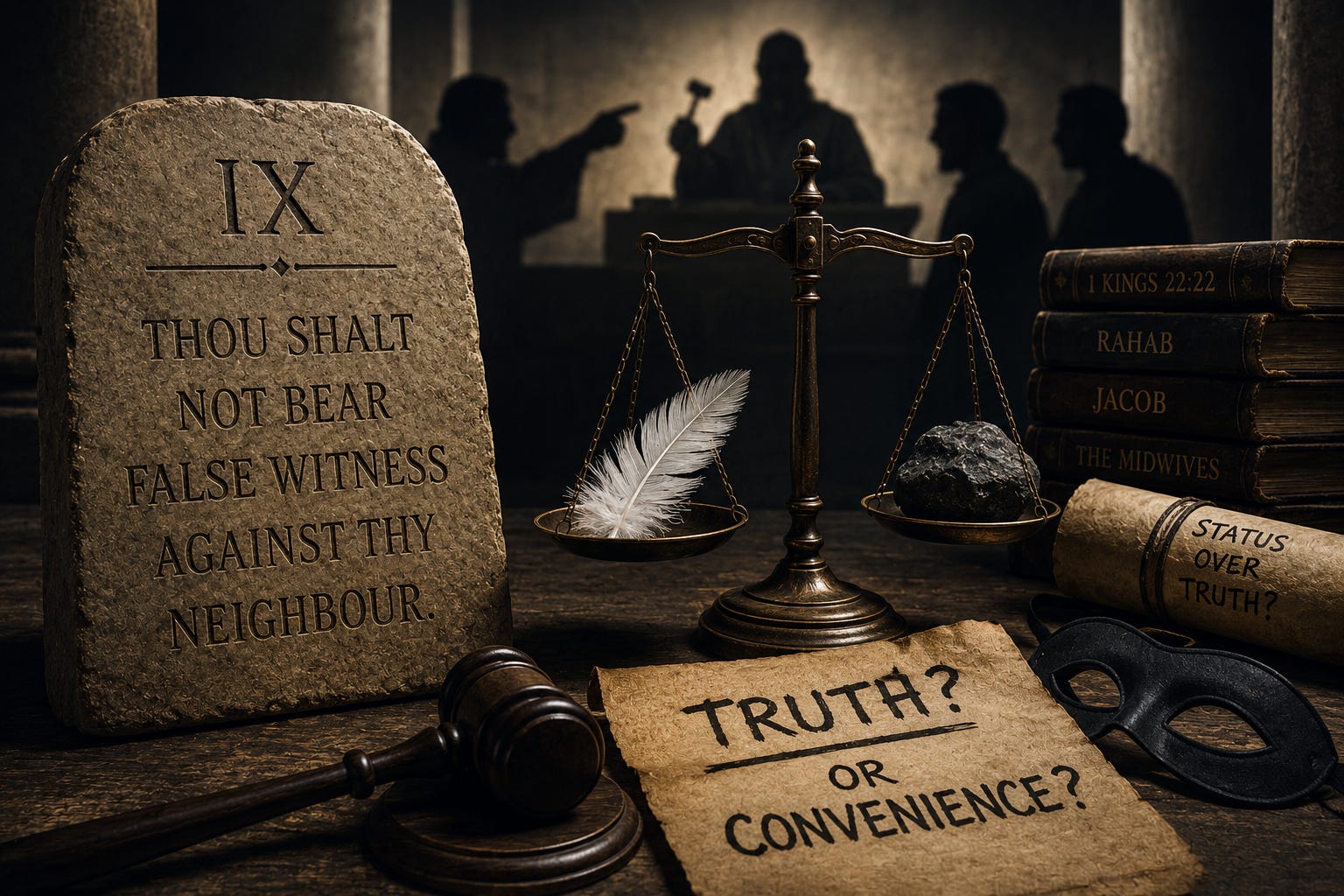
“Thou shalt not bear false witness against thy neighbour.”
— Exodus 20:16
By the ninth commandment, the architecture of society is nearly complete. Worship has been monopolised. Images restricted. Speech regulated. Time sanctified. Authority inherited. Violence licensed. Sexuality controlled. Property protected.
Now the commandments turn to something equally essential for any organised society: the administration of justice.
At first glance, the ninth commandment appears to champion honesty itself. It is often paraphrased simply as “Do not lie.” Yet that is not what the text says. It forbids bearing false witness against your neighbour — a phrase rooted in the courtroom, not in everyday conversation. The distinction matters: this is not a commandment about truth in general. It is a commandment about preserving the legal system.
Truth in the Ancient Courtroom
Ancient Israel had no forensic science — no fingerprints, no DNA, no surveillance footage. Justice depended almost entirely on witnesses. The testimony of a neighbour could determine whether someone lost property, liberty, or life itself, which is exactly what made false testimony so dangerous: it threatened the stability of the entire legal system.
Within that context, the commandment makes complete sense. No society can function if its courts cannot distinguish truth from deception. The law protects testimony because testimony protects order.
Not Every Lie Is Condemned
The wording is remarkably precise. It does not say “Thou shalt not lie.” It says “Thou shalt not bear false witness against thy neighbour” — and that difference carries profound implications.
Scripture pays little attention to most other forms of deception. Political deception, military deception, even lies told in service of God’s own purposes are, at various points, tolerated — or praised outright. The Hebrew midwives deceive Pharaoh. Rahab lies to protect the Israelite spies. Jacob deceives Isaac. God himself, in 1 Kings 22:22, sends a “lying spirit” to mislead King Ahab through false prophecy.
If honesty were an absolute moral principle, these stories would be impossible to explain. But read the ninth commandment as protecting judicial integrity rather than condemning every lie, and the contradiction largely disappears.
Truth as Social Stability
Like the eighth commandment before it, the ninth serves stability rather than abstract ethics. Its concern is maintaining confidence in institutions. False accusations destroy reputations. False testimony corrupts justice. False verdicts undermine public confidence.
The commandment protects one of civilisation’s most fragile achievements — trust in legal judgment — and says remarkably little about deception outside that setting.
Selective Honesty
This selectivity raises an uncomfortable question: if truth is sacred, why does Scripture repeatedly tolerate deception when it serves divine purposes?
Biblical narratives frequently celebrate strategic dishonesty, so long as it’s committed by the right people for the right reasons. The problem was never lying itself. The problem was lying that threatened the established order. The moral principle becomes conditional rather than universal: truth is defended when it preserves the system; deception is excused when it protects that same.
Beyond the Courtroom
Over time, religious tradition expanded the commandment far beyond its original legal setting into a general prohibition against dishonesty. Parents taught children not to lie. Churches preached honesty in daily life. Most societies today embrace this broader interpretation, because trust depends on truthful communication far beyond the courtroom.
Ironically, this expanded understanding is ethically stronger than the commandment itself. Modern ideas about integrity recognise that dishonesty damages marriages, friendships, journalism, science, politics, business, and public discourse — not merely legal proceedings. Our ethical expectations have simply grown beyond the limits of the original text.
When Institutions Fear the Truth
The irony sharpens here: religious institutions that champion the ninth commandment have not always welcomed uncomfortable truths. Throughout history, churches have concealed scandals, suppressed dissent, censored criticism, and defended doctrine even when evidence challenged long-held beliefs.
The commandment condemns false testimony. It says almost nothing about institutional honesty. This raises an unsettling possibility: perhaps the commandment was never meant to create a culture of radical truthfulness at all. Perhaps it was designed simply to keep the machinery of justice running.
The Commandment’s Legacy
The ninth commandment is often remembered as a universal defence of honesty. In reality, it is something narrower. It protects witnesses because witnesses preserve courts. It protects courts because courts preserve society. That made perfect sense in the world where it was written.
But modern ethics asks more of us than truthful testimony under oath. Integrity means telling the truth when no court is watching. It means following evidence even when it challenges cherished beliefs. It means valuing truth not because authority demands it, but because reality deserves it.
The ninth commandment protects justice. The pursuit of truth requires something greater: the willingness to question even the systems that claim to defend it.
Sources:
Barton, John. Ethics in Ancient Israel. Oxford: Oxford University Press, 2014.
Blenkinsopp, Joseph. The Pentateuch: An Introduction to the First Five Books of the Bible. New Haven: Yale University Press, 1992.
Coogan, Michael D. The Old Testament: A Historical and Literary Introduction to the Hebrew Scriptures. 3rd ed. New York: Oxford University Press, 2014.
Levinson, Bernard M. Deuteronomy and the Hermeneutics of Legal Innovation. New York: Oxford University Press, 1997.
Miller, Patrick D. The Ten Commandments. Louisville, KY: Westminster John Knox Press, 2009.
Roth, Martha T., ed. Law Collections from Mesopotamia and Asia Minor. 2nd ed. Atlanta: Society of Biblical Literature, 1997.
Walton, John H. Ancient Near Eastern Thought and the Old Testament: Introducing the Conceptual World of the Hebrew Bible. 2nd ed. Grand Rapids, MI: Baker Academic, 2018.
Westbrook, Raymond. Studies in Biblical and Cuneiform Law. Paris: Gabalda, 1988.
Wright, Christopher J. H. Old Testament Ethics for the People of God. Downers Grove, IL: IVP Academic, 2004.