
Two Creations, Two Gods?
Why the Contradictions Between Genesis 1 and Genesis 2 Matter More Than You Think

For centuries, readers have opened the Bible to its very first pages and assumed they were reading a single, seamless creation story. Genesis, after all, begins with the familiar rhythm of divine speech: “And God said…” But look closer, and the illusion of harmony starts to crumble. Genesis doesn’t tell one story of creation — it tells two. They differ not only in order and detail but also in theology, tone, and even the nature of the God they describe.
Many modern Christians are told these chapters simply “complement” each other — that Genesis 1 gives the broad overview, while Genesis 2 zooms in on humanity. That’s the standard apologetic explanation, neat and convenient. But it doesn’t hold up under serious scrutiny. Once we examine the text critically, the differences reveal far more than narrative variety; they point to entirely separate traditions, possibly even rival conceptions of God.
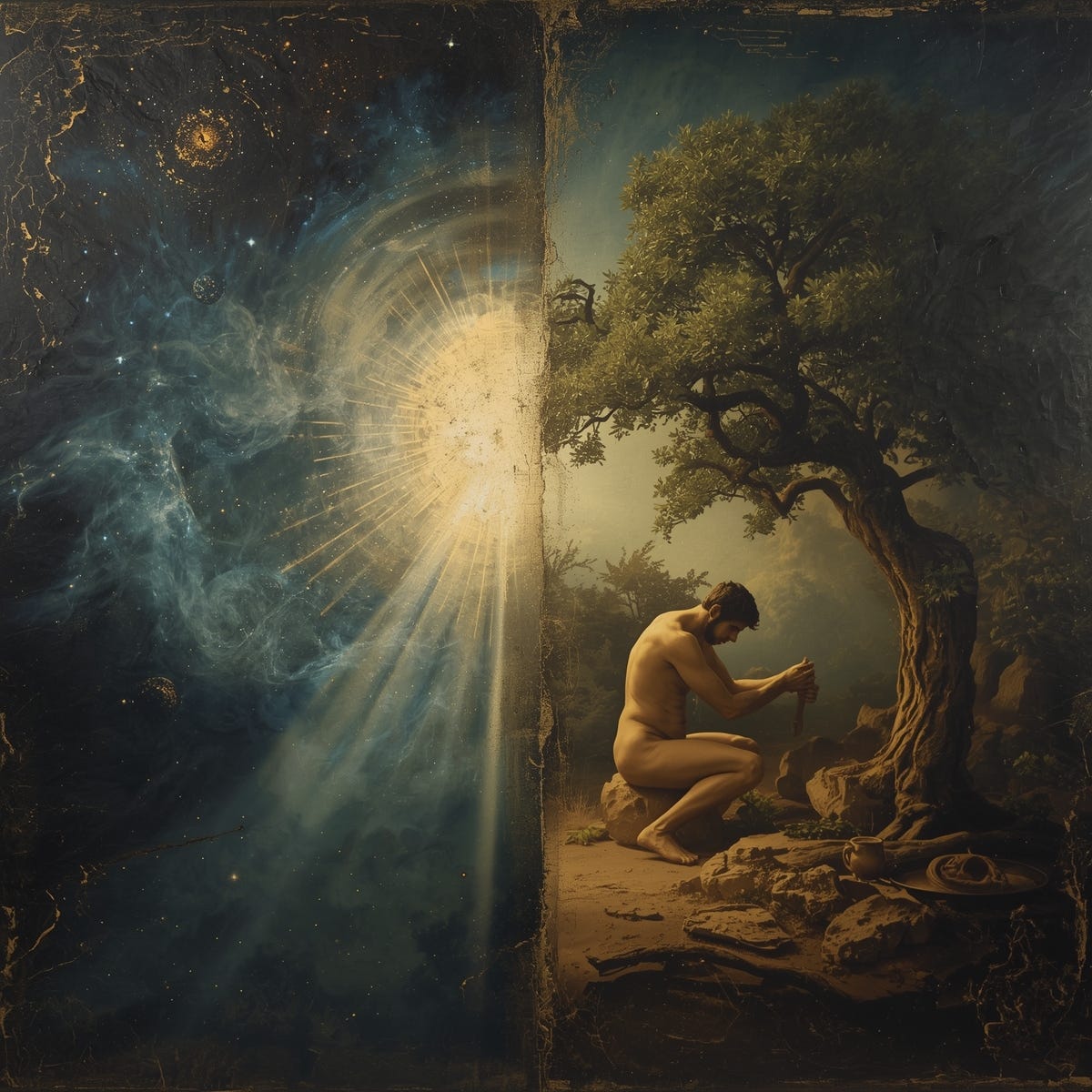
Two Accounts, Two Styles, Two Theologies
Genesis 1:1–2:3 presents a highly structured, almost poetic account of creation. Everything unfolds in orderly stages over six days. God — referred to exclusively as אֱלֹהִים (Elohim) — speaks the universe into existence. Light appears before the sun, land before plants, and plants before the very stars that should sustain them — the logic is liturgical, not scientific. This is a transcendent, cosmic deity, creating by command, distant and omnipotent.
Genesis 2:4 onwards, however, changes everything. Suddenly, we meet יְהוָה אֱלֹהִים (Yahweh Elohim) — “the Lord God.” The tone shifts from grand and cosmic to intimate and anthropomorphic. This God doesn’t speak things into being; he forms man from dust with his hands, plants a garden, shapes animals like a potter, and performs divine surgery to create woman. It’s a hands-on creator, almost human-like in behaviour.
Even the sequence of creation collapses. In Genesis 1, humanity is made last — the pinnacle of creation, described collectively as ‘male and female,’ suggesting a shared creation rather than a sequential one. In Genesis 2, man appears first, plants and animals follow, and woman is created only after Adam has failed to find a suitable partner among the beasts. These aren’t complementary details — they are opposing frameworks.
When “God” Becomes “the Lord God”
The shift in divine name isn’t accidental. Elohim is the general Hebrew word for “god,” used throughout Genesis 1 to describe a universal, majestic creator. Yahweh, on the other hand, is the personal name of Israel’s tribal deity — the same God who will later demand obedience, sacrifice, and fear.
Scholars have long identified these differing divine names as evidence of separate sources within the Pentateuch — what’s known as the Documentary Hypothesis. The “Priestly” author (P-source) likely wrote Genesis 1, reflecting a late, formalised theology that emphasised order, Sabbath, and divine transcendence. Genesis 2 belongs to the much older “Yahwist” source (J-source), rooted in earthy storytelling, local myth, and an almost pagan closeness between God and man.
So when the text shifts from Elohim to Yahweh Elohim, we’re witnessing an editorial stitching together of two incompatible traditions. The redactors didn’t hide the seams very well — perhaps because they weren’t bothered by consistency in the same way modern readers are. But for anyone claiming divine authorship or perfect inspiration, the cracks are impossible to ignore.
The Order of Creation: A Contradiction by Design
Let’s lay it out plainly:
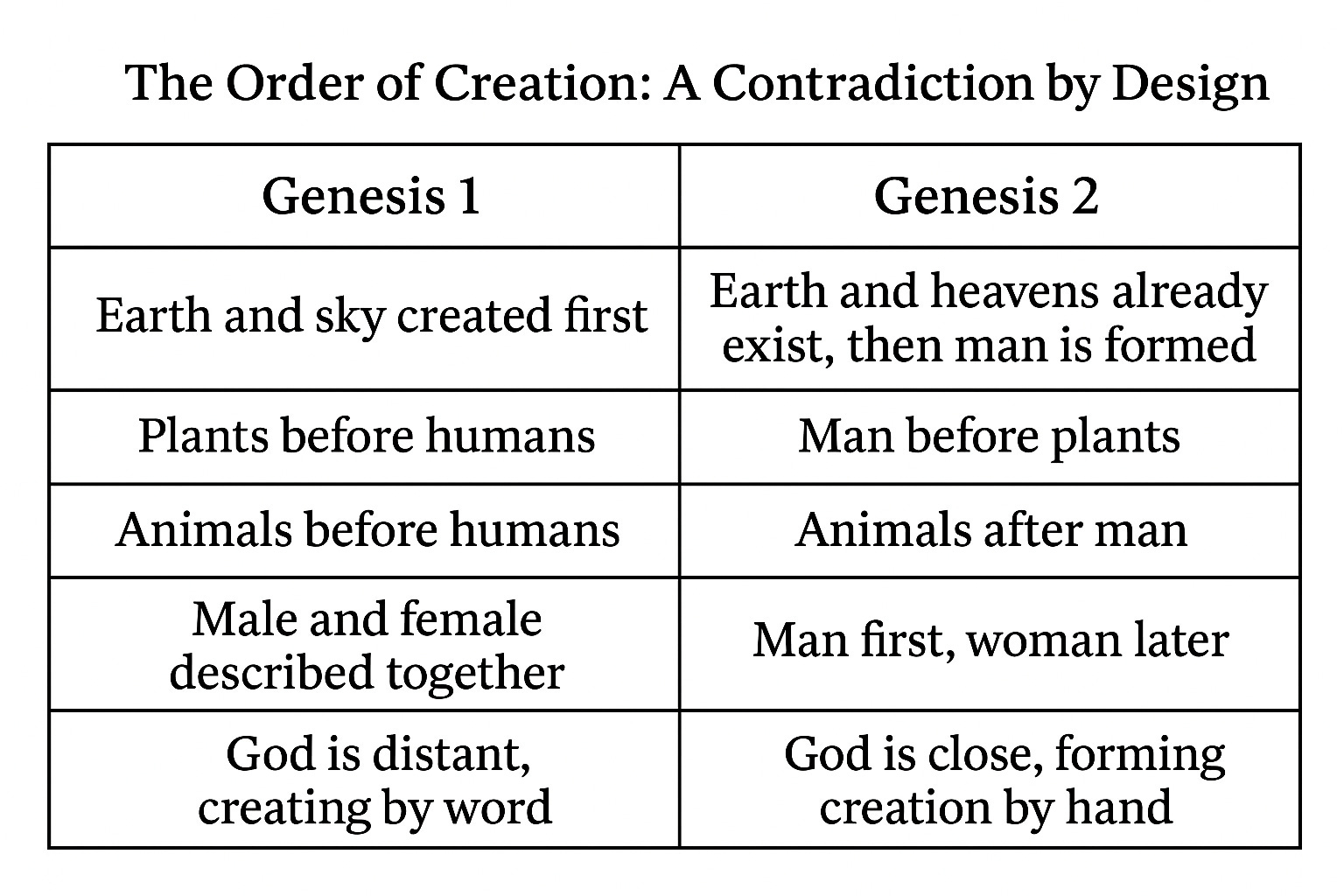
No amount of apologetic gymnastics can make these align. The order of events simply doesn’t match. And this matters because the Bible’s entire claim to divine authority rests on the premise that it conveys truth — not just moral or spiritual truth, but the truth of divine revelation. If the very first two chapters can’t agree on how creation happened, what does that say about the reliability of the rest?
Why Two Stories?
To ancient Israel, combining multiple creation myths wasn’t strange — it was strategy. Early scribes worked to unify competing regional traditions into one national scripture. The Babylonian exile (6th century BCE) forced a theological crisis: if Yahweh was truly supreme, how could his people be conquered by Babylon’s gods? The solution was to recast Israel’s tribal deity as the creator of all things.
The Priestly writers of Genesis 1 thus crafted a cosmic hymn, modelled partly on Babylonian myths like the Enuma Elish, but replacing Marduk with a single, all-powerful Elohim. By contrast, the older Yahwist story of Genesis 2–3 survived as a folk narrative, explaining human origins, suffering, and mortality through the myth of Adam and Eve.
When these traditions were edited together, no one dared discard either — both were considered sacred. The result is what we have now: a theological patchwork that inadvertently exposes its own human authorship.
What the Contradiction Reveals
For believers, these differences are often dismissed as literary “perspective.” But that argument quickly falls apart once you apply the same logic elsewhere. People will say the stories “complement” each other — that the order doesn’t matter, that the gist is the same. Yet if we applied that reasoning to any other account of events, we’d call it what it is: a contradiction.
The inconsistencies in Genesis aren’t incidental; they expose the evolution of Israelite religion itself. The shift from Yahweh the local god to Elohim the universal creator mirrors the transformation of a polytheistic culture into a monotheistic ideology. In other words, Genesis 1 and 2 don’t just disagree — they represent two stages of religious development.
Genesis 1 tells us about the theology of priests trying to systematise the faith; Genesis 2 reflects the older, mythic imagination of storytellers who pictured God as a being that walked and talked in gardens. The contradiction isn’t a flaw to be patched — it’s a fossil record of belief evolving.
Why It Matters
Some might shrug and say, “So what? They’re both about creation, aren’t they?” But that misses the point entirely. If the Bible begins with contradiction, then claims of divine inerrancy are broken from page one.
This isn’t just about creation myths — it’s about trust. When religious leaders insist that Scripture is “the Word of God,” they invite readers to surrender reason in favour of faith. Yet Genesis 1 and 2 show that the Bible is not a unified revelation but a compilation of competing voices, stitched together by human editors with differing agendas.
And if the very foundation is human, then so are the walls built upon it — from doctrine to dogma, from morality to meaning. The contradictions between Genesis 1 and 2 don’t merely raise questions about creation; they challenge the entire notion that the Bible is a consistent, divine narrative at all.
A Closing Thought
Perhaps the irony is that the Bible’s editors, in merging two stories, unintentionally did the modern reader a favour. They left the seams visible. They gave us evidence that faith was never simple, never monolithic, and never divinely dictated.
For those still clinging to the idea that Scripture is infallible, the opening pages of Genesis should be enough to spark doubt. Two accounts, two gods, two worldviews — and one unavoidable conclusion: the Bible is not the word of God, but the record about gods, written and rewritten by men.
Sources:
Alter, Robert. The Five Books of Moses: A Translation with Commentary. New York: W. W. Norton & Company, 2004.
Collins, John J. Introduction to the Hebrew Bible. Minneapolis: Fortress Press, 2014.
Friedman, Richard Elliott. Who Wrote the Bible? New York: HarperOne, 1997.
Lemche, Niels Peter. The Israelites in History and Tradition. Louisville: Westminster John Knox Press, 1998.
Rogerson, John W. Genesis 1–11: A Commentary. Sheffield: Sheffield Academic Press, 1991.