
When Belief Meets Responsibility
Why Personal Faith Has No Authority in the Workplace

Every workplace runs on a simple assumption. When we board an aircraft, undergo surgery, send our children to school, or enter a courtroom, we expect the people responsible for us to perform their duties according to professional standards rather than personal beliefs. Yet when religious conviction conflicts with those standards, society faces an uncomfortable question: should faith be permitted to override the responsibilities that come with a profession?
Many believers insist that religion should guide everything they do. On the surface, that sounds admirable. Integrity and consistency are generally seen as virtues. But difficulties arise when religious commitments conflict with the obligations that come with certain professions. At that point, society must decide which authority should prevail: faith or responsibility.
When Conviction Collides with Duty
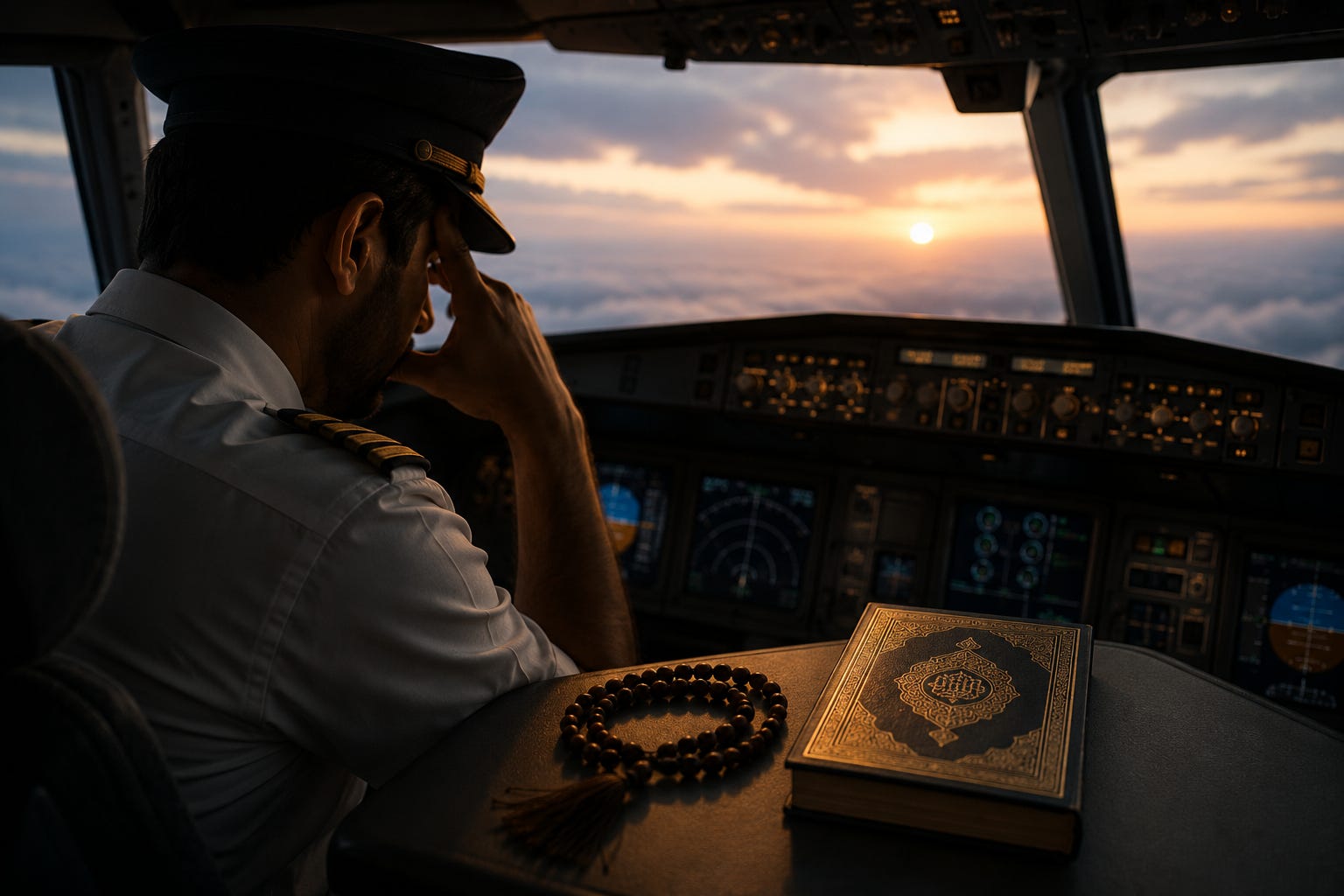
Pakistan International Airlines provides a revealing example. Following the fatal crash of Flight 8303 in 2020, investigators concluded that pilot error was responsible for the disaster. However, concerns over fatigue, dehydration, and impaired judgement during Ramadan fasting prompted the airline to issue directives advising, and later prohibiting, pilots and cabin crew from fasting while on duty. The airline recognised a simple reality: whatever spiritual value fasting may hold, the safety of passengers must come first.
This principle is hardly controversial in other areas of life. A surgeon is expected to follow medical evidence rather than divine revelation. An engineer must obey the laws of physics, not the teachings of a holy book. A judge should apply the law impartially rather than interpret cases through the lens of personal theology. Professional competence demands objective standards, and those standards exist precisely because the people we serve depend on them.
In everyday life, we constantly place our trust in strangers. We trust doctors with our health, pilots with our lives, and teachers with our children’s education. That trust is possible only because society expects those professions to be governed by expertise and evidence rather than by individual preference. The moment personal conviction becomes more important than professional obligation, that trust begins to erode.
The Problem with Religious Exemptions
Yet religion frequently seeks exemptions from those standards. In 2012, a UK pharmacist refused to dispense the morning-after pill to a woman on religious grounds, leaving her to travel to another pharmacy during a time-sensitive medical need. The pharmacist’s religious conviction, however sincerely held, had consequences for someone else’s health.
Civil servants have similarly objected to carrying out legal duties, and teachers have attempted to introduce religious views into scientific education. In each case, personal beliefs are elevated above professional obligations. The question then becomes whether professions exist to serve the public according to established standards, or to accommodate every religious conviction held by those within them.
This issue extends far beyond religion. Society generally rejects the idea that a professional should be able to disregard standards because of political ideology, personal philosophy, or deeply held feelings. A doctor cannot prescribe medication according to astrology. A judge cannot ignore the law because they have a different moral outlook. A pilot cannot substitute procedure with intuition. Why should religion occupy a unique category that places it beyond scrutiny?
Why Professional Standards Exist
Professional standards are not arbitrary impositions. They are codified through licensing requirements, codes of conduct, and legal duties of care — frameworks developed specifically to ensure that the people entrusted with our wellbeing are accountable to something beyond their own conscience.
A doctor who departs from clinical guidelines, a lawyer who ignores case law, or a pilot who disregards safety procedures cannot simply appeal to personal conviction as justification. The moment a professional accepts their role, they accept its obligations.
The reason these standards exist is simple: human beings are fallible. We make mistakes. We have biases. We are prone to wishful thinking and overconfidence. Professional disciplines emerged precisely because relying on personal judgement alone proved insufficient. Medicine replaced superstition with scientific testing. Engineering replaced guesswork with mathematics. Aviation replaced instinct with checklists and procedures written in the blood of previous disasters.
The purpose of professionalism is not to suppress individuality. It is to minimise avoidable harm.
Religion Already Recognises the Principle
None of this means that religious people should abandon believes. Honesty, compassion, diligence, and integrity are qualities that enrich any workplace. The problem arises when supernatural convictions begin to override evidence, safety, or the rights of others. At that point, religion ceases to be a source of personal inspiration and becomes an obstacle to professional responsibility.
Ironically, even many religions recognise this principle. Islamic jurisprudence contains well-developed provisions exempting travellers, the sick, and those facing genuine hardship from fasting — an acknowledgement that practical necessity can legitimately take precedence over ritual obligation.
Christianity contains Jesus’ famous instruction to render unto Caesar what belongs to Caesar, a recognition that civic and religious authority occupy different domains. Many theological traditions have long wrestled with the boundary between sacred duty and worldly responsibility and have generally concluded that the two are not always the same thing.
The argument for keeping religious conviction out of professional decision-making is therefore not simply a secular imposition. It has precedent within religious thought itself.
Keeping Faith in Its Proper Place
Perhaps faith belongs where it has always been strongest: in the private lives of individuals and in communities of worship. A pilot’s passengers do not care about the pilot’s theology. They care that the aircraft lands safely. Patients do not ask whether their doctor has prayed enough. They want competent treatment. Employers do not hire accountants to interpret scripture. They hire them to balance the books.
Modern society functions because we have largely separated expertise from belief. We expect evidence rather than revelation, standards rather than convictions, and accountability rather than authority claimed in the name of a god.
That separation was not created because religion is uniquely bad. It was created because no personal belief system — religious or otherwise — is sufficient to guarantee competence. Expertise exists precisely because conviction can be wrong.
And when hundreds of lives depend on the decisions of a single person, “God told me so” is not, and never has been, a professional qualification.
Sources:
Beauchamp, Tom L., and James F. Childress. Principles of Biomedical Ethics. 8th ed. New York: Oxford University Press, 2019.
Civil Aviation Authority (United Kingdom). CAP 737: Flight Crew Human Factors Handbook. Gatwick: Civil Aviation Authority, 2016.
General Pharmaceutical Council. Standards for Pharmacy Professionals. London: General Pharmaceutical Council, 2017.
International Civil Aviation Organization. Human Factors Training Manual (Doc 9683). 2nd ed. Montreal: ICAO, 1998.
Pakistan Aircraft Accident Investigation Board. Investigation Report: Pakistan International Airlines Flight PK8303, Airbus A320-214 AP-BLD, Near Jinnah International Airport, Karachi, 22 May 2020. Islamabad: Government of Pakistan, 2020.
Pew Research Center. The Global God Divide. Washington, DC: Pew Research Center, 2020.
World Medical Association. WMA International Code of Medical Ethics. Ferney-Voltaire, France: World Medical Association, 2022.