
Why Do Humans Believe?
The Gods We Create: Why Humans Can't Let Go

From the dawn of civilisation, humans have gazed at the heavens and seen gods staring back. Whether it was the sun deity Ra in ancient Egypt, Zeus hurling lightning from Mount Olympus, or the monotheistic god of Abrahamic traditions, belief in deities has been a near-universal human trait. But why? What is it about the human animal that compels us to believe in divine beings?
Believers may hold onto their faith for a variety of reasons. Some are raised in religious environments where belief is instilled from childhood, making it deeply ingrained in their identity. Others find comfort in religion during times of hardship or uncertainty. Still, others may consciously choose to believe, seeing it as a way to provide structure and meaning to their lives. The reasons for belief can be different from the reasons people continue to hold onto it - social pressure, fear of the unknown, or simply the difficulty of letting go of long-held convictions. In this article, I will explore the many dimensions of belief, examining its origins, benefits, and potential harms.
The Evolutionary Advantage or a Gateway to Delusion?
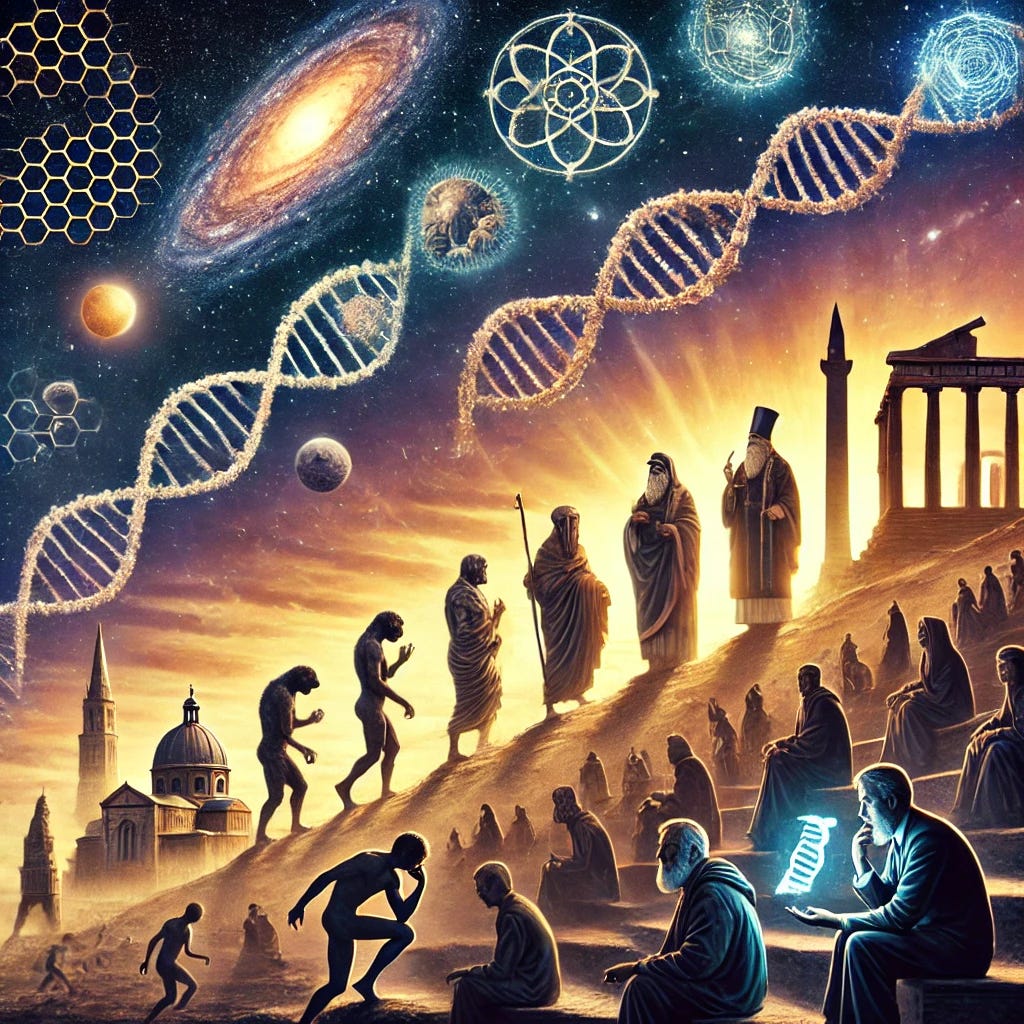
One theory suggests that belief in gods is an evolutionary byproduct. Early humans who saw patterns - real or imagined - had a survival advantage. If rustling in the grass was assumed to be a predator rather than the wind, the cautious observer was more likely to live another day. This hyperactive agency detection may have extended to natural phenomena: thunder, floods, and disease were interpreted as the actions of conscious, supernatural forces. Over time, these imagined agents became gods, providing explanations for the unknown and a sense of control in an unpredictable world.
However, in the modern era, this cognitive bias often leads to false conclusions rather than survival benefits. The same instinct that once protected us now fuels conspiracy theories, superstition, and resistance to scientific truths. While assuming danger at every turn made sense in prehistoric environments, today’s world is governed by evidence and reason. Clinging to supernatural explanations in an age of scientific discovery is not just unnecessary - it can be actively harmful, encouraging people to accept comforting falsehoods over uncomfortable realities.
Beyond individual survival, belief in an all-seeing deity likely reinforced social cohesion. The fear that an omnipotent being was watching - even when no one else was - helped enforce moral behaviour within groups. This increased trust and cooperation, giving religious tribes an advantage over less cohesive ones. However, in modern society, this function has largely been replaced by secular institutions: laws, surveillance, and shared ethical principles. Ethical behaviour is no longer dictated by religious oversight but by human rights, reason, and societal well-being. If anything, blind adherence to religious dogma now fosters division rather than unity, allowing outdated and often harmful moral codes to persist in a world that has moved beyond them.
Furthermore, as scientific understanding expands, the need for divine explanations continues to shrink. Medicine, psychology, and cosmology have dismantled much of the mystery that once required supernatural answers. Yet religious dogma persistently hinders progress - whether through opposition to evolutionary theory, resistance to medical advancements like stem cell research, or the obstruction of equal rights in the name of divine decree. What was once an evolutionary advantage has, in many cases, become a roadblock to human advancement, chaining societies to archaic beliefs that serve no function in a world driven by reason and discovery.
Faith: A Comfort and a Curse
Humans are uniquely aware of their own mortality, and the idea of a finite existence can be terrifying. Religion offers an antidote: a promise that death is not the end. The concept of an afterlife, reincarnation, or divine justice provides psychological comfort in an often brutal and indifferent world. The belief that suffering has meaning, or that a higher power has a plan, can make life's struggles more bearable. As explored in Why Suffering and Evil Challenges Belief, however, this notion can also create theological dilemmas - why would a benevolent god allow suffering at all?
Yet, this comfort can also lead to extreme behaviour. If one believes that divine will supersedes human law, then morality can become dangerous. The same religious texts that bring solace can also be used to justify violence, persecution, and oppression. Throughout history, belief in gods has been cited as justification for war, slavery, and discrimination. When belief in the divine overrides reason and empathy, it ceases to be a mere source of comfort and becomes a force for destruction.
This is particularly concerning when moral codes are interpreted in rigid and harmful ways. As discussed in Is Morality from the Divine?, the belief that morality is dictated by a deity can be deeply problematic. If moral standards are seen as absolute and unquestionable because they stem from divine authority, then outdated or harmful practices can persist for centuries. Whether it be the justification of slavery, oppression of women, or the condemnation of LGBTQ+ individuals, religious moral codes can lag behind evolving human ethics. Conversely, if morality is understood as a human construct based on empathy and societal wellbeing, we are free to refine our ethical frameworks to align with the best available understanding of justice and human flourishing.
The Human Quest for Meaning
Beyond survival and comfort, humans have an innate drive to seek meaning. We are storytellers, pattern-seekers, and philosophers. A universe devoid of purpose is unsettling, so we create narratives that place us at the centre of a grand cosmic story. Gods provide ultimate meaning, answering questions that humans struggle with: Why is there something rather than nothing? What is the purpose of life?
Yet, while religion offers poetic answers, science provides tangible ones. The reason there is something rather than nothing can be explored through physics and cosmology - the Big Bang, quantum fluctuations, and the laws of thermodynamics offer explanations grounded in evidence rather than mythology. As for the purpose of life, the answer does not need to come from a divine being. Life’s purpose is what we make of it - whether it be love, knowledge, creation, or the pursuit of understanding. Morality and meaning are not divine gifts; they are human constructs, shaped by empathy, experience, and reason.
The search for meaning itself is a deeply human experience that extends beyond religion. While religious narratives provide meaning through divine purpose, secular frameworks derive meaning from human connection, intellectual discovery, and artistic expression. Rather than searching for a cosmic entity to dictate purpose, we can acknowledge that meaning is self-created and ever-evolving. This shift in perspective liberates humanity from religious dogma while still fulfilling our psychological need for significance.
The Inescapable Gods
Even in secular societies, belief in something greater than ourselves persists, whether through spirituality, superstition, or ideological movements that take on religious characteristics. Some replace deities with abstract concepts like fate, destiny, or the “universe” as a guiding force. But perhaps the real question is not whether we need gods but whether we can let go of outdated beliefs that no longer serve us. If the human mind is wired for belief, then we must choose wisely what to believe in - truth, reason, and progress over blind faith and dogma.
The time has come to move beyond ancient superstition. Religion has outlived its usefulness, offering nothing that secular reason and humanist values cannot provide in a superior form. Rather than clinging to gods of our own invention, we should embrace the vastness of an indifferent universe and find purpose in the only thing that truly matters - each other. Humanity does not need gods; it needs courage, knowledge, and the will to create a better world free from the shackles of divine illusion.
Perhaps the gods exist only in our minds, or perhaps they exist beyond them. Either way, the human animal, for all its rationality, appears incapable of fully abandoning the divine. The question remains: do we believe in gods because they are real, or because we cannot bear a world without them?
Sources:
Boyer, Pascal. Religion Explained: The Evolutionary Origins of Religious Thought. Basic Books, 2001.
Dawkins, Richard. The God Delusion. Bantam Press, 2006.
Harari, Yuval Noah. Sapiens: A Brief History of Humankind. Harper, 2015.
Harris, Sam. The End of Faith: Religion, Terror, and the Future of Reason. W.W. Norton & Company, 2004.
Pinker, Steven. The Better Angels of Our Nature: Why Violence Has Declined. Penguin, 2011.
Wilson, David Sloan. Darwin's Cathedral: Evolution, Religion, and the Nature of Society. University of Chicago Press, 2002.